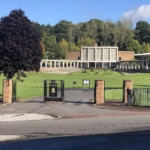



Leverndale Hospital is an NHS mental health hospital at 510 Crookston Road, Glasgow G53 7TU. NHS Greater Glasgow and Clyde (NHSGGC) runs it, and it looks after adults and older adults who need to stay in hospital. It also runs perinatal, forensic and learning disability services. The old buildings on the hill opened in 1895 as the Govan District Asylum and are now part of a housing development, with the tall water tower kept as a landmark for Crookston and Pollok.
Last checked: 23 October 2026.
Leverndale Hospital at a glance
| Address | 510 Crookston Road, Glasgow G53 7TU |
| Phone | Main switchboard 0141 211 6605 |
| Run by | NHS Greater Glasgow and Clyde |
| What it does | In-patient mental health care for adults and older adults, plus perinatal, forensic and learning disability services |
| Nearest station | Crookston, about a 13 minute walk (the station has no car park) |
| Buses | First Glasgow 3 and X8 stop outside |
| Parking | Free, according to NHSGGC |
| Visiting | No set times on the mental health wards, so ring the ward first |
Where is Leverndale Hospital?
Leverndale sits on a hill off Crookston Road (the A736), in Crookston on the south-west side of Glasgow, with Pollok just to the south. The site has two entrances on Crookston Road, and Entrance A is the one on the Crookston station side.
Most of the wards are off Entrance A. Entrance B is for the Administration Building, the pharmacy, Campsie Ward and Bute Ward, among other things. NHSGGC lists the wards and their phone numbers on the Leverndale Hospital page, so check which entrance you need before you set off.
How to get to Leverndale Hospital
By train
Crookston station is the nearest, and NHSGGC says it’s about a 13 minute walk to the hospital. It’s on the Paisley Canal line, with ScotRail trains between Glasgow Central and Paisley Canal. National Rail lists step-free access to all platforms and ticket machines, but no parking at the station, so don’t plan on driving there. Fares and Zonecard tickets are in our Glasgow train guide.
By bus
First Glasgow’s 3 and X8 both stop outside the hospital, at a stop called Leverndale Hospital. The 3 runs between Drumchapel and Govan through Partick, the city centre, Shawlands and Silverburn. On weekdays it stops at Leverndale about every 10 to 15 minutes each way in the daytime, with fewer buses on Sundays. The X8 is a loop out from Buchanan bus station via Silverburn and Pollok, and on weekdays it runs about every half hour.
From the city centre, First’s timetables put the journey at 30 to 45 minutes on the X8 and around 45 minutes on the 3. The X8 is quicker, but the 3 comes far more often, so it’s the easier one to just turn up for. Check times on the First Bus timetables page or Traveline Scotland before you go. Fares and day tickets are in our Glasgow bus guide.
By car and parking
Use G53 7TU for the sat nav. NHSGGC says parking is free at all its sites. It has a four hour limit at hospitals where spaces are in short supply and Leverndale isn’t on that list, but local managers can set their own rules, so check the signs when you arrive. If you’re driving in from further afield, our driving in Glasgow guide has the details on parking, the Low Emission Zone and the Clyde Tunnel.
On foot or by bike
NHSGGC has a walking and cycling map of the hospital and the streets around it. It shows bike stands and shelters on the site, and National Cycle Network route 7 reaching the hospital at Entrance A. For bike hire and routes across the city, see our cycling in Glasgow guide.
There are also three walking routes that start at the hospital, called the Meander for Mental Health routes. The blue route (2.1 km) and the green route (1.9 km) take about 30 minutes each, and the yellow route (3.4 km) takes about 50.
Taxis and patient transport
A black cab or private hire car is the simple option if you don’t fancy the bus, and our Glasgow taxis guide has fares and apps. If you’re a patient who needs ambulance transport to an appointment or admission, NHSGGC’s Patient Transport Service, which the Scottish Ambulance Service provides, is for people with a medical condition or mobility need. Some patients on a low income or certain benefits can claim back travel costs, though NHSGGC says it won’t repay taxi fares.
Visiting Leverndale Hospital
NHSGGC says there are no set visiting times on its mental health wards, so you can visit at any time during the day. It asks you to talk to the person you’re visiting about what they’d like and what times suit you both, then speak to the ward staff about your plans.
The Leverndale Hospital page adds that visiting still needs to be carefully managed, and says to contact the ward or unit directly to talk it through. The ward numbers are listed there, and the main switchboard is 0141 211 6605. The full guidance is on NHSGGC’s mental health visiting page.
Nursing staff will tell you where visiting happens, which can be a communal area or a visiting room. Ask the nurse in charge what’s safe to take in. NHSGGC gives glass bottles, knives, medication and plastic bags as examples of things that aren’t, and says any electrical equipment should be handed to staff to be safety checked.
For children, NHSGGC says staff talk it through with the patient and their family, and use a designated family area where they can. If you’re taking your family member or friend off the ward, always let the nurse in charge know.
If you need support yourself
Leverndale looks after people who are admitted for in-patient care. If you’re struggling yourself, NHSGGC says to start with your GP, who can refer you to local mental health services. If it’s urgent or you’re in crisis, call NHS 24 on 111, and call 999 in a medical emergency.
Samaritans are there around the clock on 116 123, and the call is free. If you’re not registered with a GP, our GP registration guide shows how.
Leverndale Hospital history
Leverndale opened in 1895 as the Govan District Asylum at Hawkhead, and you’ll also see it called Hawkhead Asylum. It was built for the Govan district, and “asylum” was simply the official name for this kind of hospital back then.
- 1890 to 1895: the main buildings go up on the hill, to a design by Malcolm Stark and Rowntree that won a competition. The memorial stone is dated 3 October 1893.
- 1895: it opens as the Govan District Asylum, with room for 400 patients. That had grown to 520 by 1908.
- 1903 to 1905: extensions are added by the architects H and D Barclay.
- 1930: Glasgow Corporation takes it over.
- 1937: the resident population peaks at over 1,000.
- 1948: it joins the new NHS as Hawkhead Mental Hospital.
- 1964: it becomes Leverndale Hospital, after a spell as Hawkhead Hospital from 1961.
- Early 1970s: a 120 bed unit for older patients is added.
- 1980s and 1990s: the original buildings go out of use, and the hospital moves into newer blocks on part of the site.
- 2003 to 2006: the old Kelburne and Towerview blocks are converted into homes, with parts of them demolished.
Historic Environment Scotland (HES) describes the main building as Renaissance in style, with stone walls, slate roofs and linked blocks laid out symmetrically on the hilltop. A tall assembly hall stands in the middle of the north side, and the administration block is the south range. The listing record even gives the names of the old blocks, which include Leven, Shiel, Nevis, Etive and Morven.
Glasgow City Council’s Crookston Heritage Trail adds that the hospital prided itself on being self-sufficient, with its own farm, laundry, bakery, chapel and fire service, and even a nine-hole golf course.
The dates above come from HES, The Glasgow Story, The National Archives’ hospital records listing and the council’s heritage trail, which all have more detail if you want it.
The Leverndale water tower
The tower is the part of the old hospital that stands out. HES describes it as a tall square tower sitting off-centre, and calls it a prominent landmark. Its online archive files the tower and the hall together as Leverndale Hospital Water Tower & Hall (Former).
HES lists the tower and the hall at Category A. That’s the top of its three listing categories, and HES describes it as being for outstanding examples of a particular period, style or building type. The listing dates from 15 December 1970, and the archive has an aerial photo of the tower from 2019.
What happened to the old buildings
The original buildings went out of use in the 1980s and 1990s, and the hospital carried on in newer blocks on part of the site. Glasgow City Council’s Crookston Heritage Trail says the old buildings, with some demolition and new additions, now form part of a housing development.
HES records that the old Kelburne block was converted to homes in 2003 and 2004, with parts of the original building demolished, and it’s now Parklands View. The council adds that the Towerview block, the grandest in the hospital complex, was converted to homes between 2003 and 2006, with some parts demolished. It’s now known as Parklands Oval.
The council says the huge water tower was kept as the centrepiece of the housing and is one of the most prominent landmarks in the area. If you go for a look at it, keep to the public roads and paths. It’s a working hospital with homes next door.
Listed buildings at Leverndale
HES has four listings for the site, and each one has its own record on its portal.
| Building | Category | Listed |
|---|---|---|
| Towerview Unit (listed A for its tower and hall) | A | 15 December 1970 |
| Kelburne Unit (now homes on Parklands View) | B | 15 December 1970 |
| Female nurses’ home | B | 17 February 1992 |
| Gate lodge (1896 datestone) | C | 17 February 1992 |
Leverndale Hospital photos and old records
HES’s online archive, trove.scot, has 30 digital images of the site, including aerial shots and an old interior view. HES has put a content warning on the record because some of the material could be upsetting. The Glasgow Story also has a 1975 photo of the water tower and chapel from the Heatherbank collection at Glasgow Caledonian University.
If you’re tracing a relative who was a patient or worked here, The National Archives lists what NHS Greater Glasgow Archives holds for Leverndale. That’s admission records from 1895 to 1984, clinical records from 1895 to 1996 and staff records from 1898 to 1923, though the listing was last updated in 1999. NHSGGC says its board archive is still being made accessible, so you’ll need to email the archive team with as much detail as you can. Records of someone who has died can only go to people the law entitles to see them, such as the patient’s personal representative, and NHSGGC explains who counts on its access to records page.
Leverndale Hospital FAQs
What’s the address of Leverndale Hospital?
It’s 510 Crookston Road, Glasgow G53 7TU, in Crookston on the south-west side of the city.
What’s the phone number for Leverndale Hospital?
The main switchboard is 0141 211 6605. Each ward has its own number, and NHSGGC lists them on its Leverndale Hospital page.
What is Leverndale Hospital used for today?
NHSGGC says it provides in-patient mental health care for adults and older adults, including continuing care. It also runs perinatal, forensic and learning disability services from the site, and has a Mother and Baby Unit. The original Victorian buildings went out of use in the 1980s and 1990s, so the hospital now works from newer blocks.
Can you visit someone at Leverndale Hospital?
Yes, but contact the ward or unit first. NHSGGC says visiting at Leverndale still needs to be carefully managed. It has no set visiting times on its mental health wards, and it asks you to talk to the person you’re visiting and then the ward staff about your plans. The ward numbers are on the hospital page.
Is parking free at Leverndale Hospital?
Yes, according to NHSGGC, which says parking is free at all its sites. Leverndale isn’t one of the hospitals with a four hour limit, but check the signs when you arrive. Crookston station, the nearest, has no car park.
What is the tower at Leverndale Hospital?
It’s the old water tower from the original 1890s hospital. HES lists the tower and the assembly hall at Category A, and Glasgow City Council says the tower was kept as the centrepiece of the housing development.
What happened to the old Leverndale Hospital buildings?
They went out of use in the 1980s and 1990s. The Kelburne and Towerview blocks were converted to homes in the 2000s, with some parts demolished.
Was Leverndale Hospital an asylum?
Yes. It opened in 1895 as the Govan District Asylum, which was the official name for this kind of hospital then. It became Hawkhead Mental Hospital in 1948 and Leverndale Hospital in 1964.
Is it Leverndale or Levendale?
It’s Leverndale, and has been since 1964. Folk sometimes type it as Levendale or Leverdale.